Pink Urine After a Workout: Exercise, Dehydration, or Rhabdo?
Quick Answer
Pink or light red urine after a workout is most often exercise-induced hematuria—a benign, self-limited leak of red blood cells caused by the physical stress of exercise. It is painless, appears after intense activity, and typically clears on its own within 24 to 72 hours of rest and hydration. A repeat urine test after 72 hours should be negative.
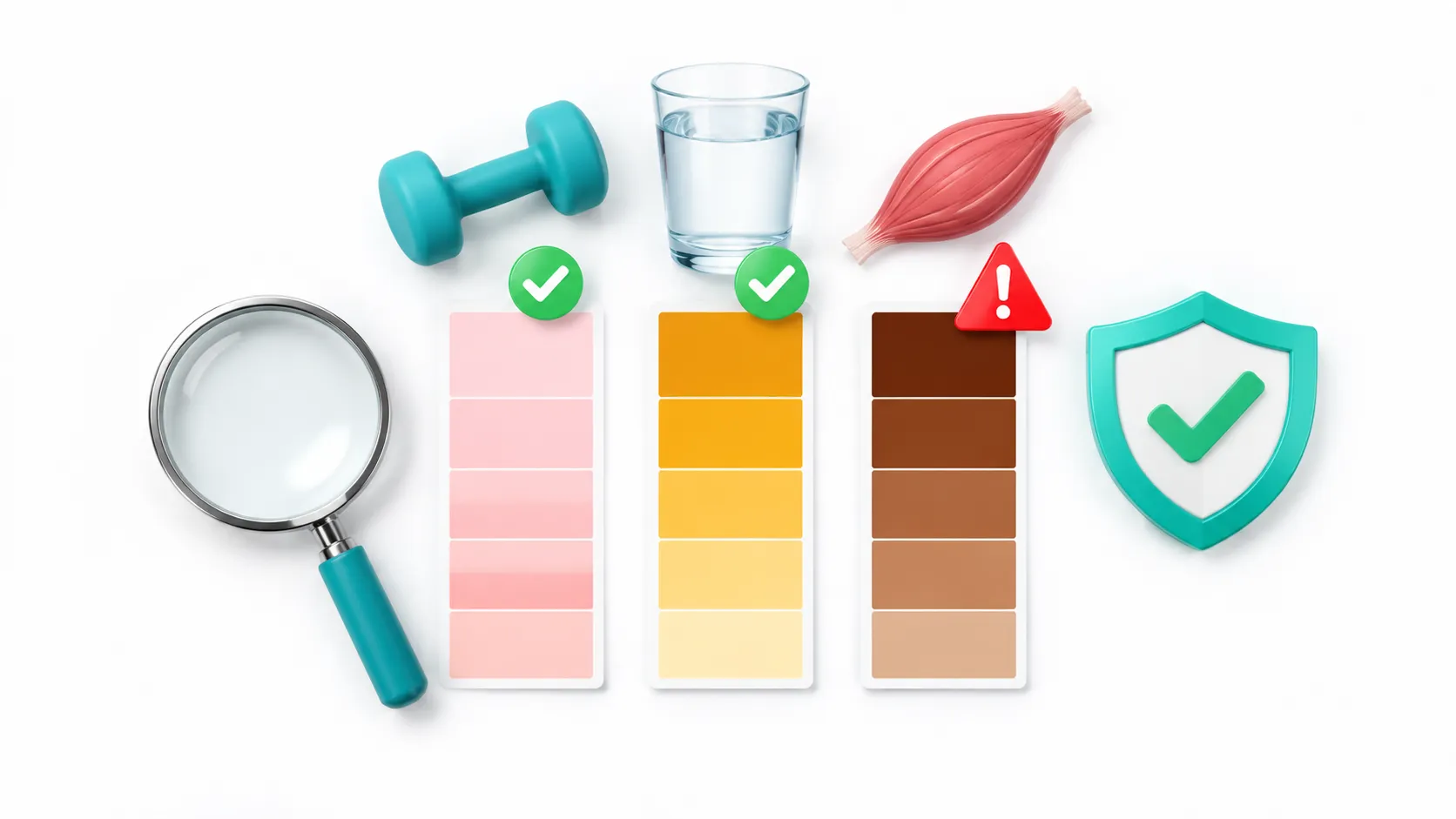
The two other possibilities are different in important ways. Dehydration usually concentrates urine toward dark yellow or amber, not pink; it does not cause true red discoloration on its own. Rhabdomyolysis is the emergency: it produces dark brown, cola-colored, or tea-colored urine—not light pink—and it comes with muscle pain, weakness, or swelling, often one to three days after extreme or unaccustomed exercise. Rhabdo requires urgent care.
The practical rule is simple: light pink, painless, and clearing within three days is usually exercise hematuria. Dark cola-colored urine with muscle symptoms is rhabdo until proven otherwise. Use the after-exercise urine guide to compare your pattern, and read on for how to tell the three apart.
Exercise-Induced Hematuria: The Benign, Self-Limited Cause
Exercise-induced hematuria is well documented in runners and other endurance athletes. Studies of middle-distance track athletes found that 90% experienced post-workout hematuria at least once, with the highest incidence after high-intensity efforts. It is not a sign of kidney disease.
The mechanisms are mechanical and physiological:
- Bladder jostling. During running, the flaccid posterior wall of the bladder repeatedly impacts the bladder base, causing minor trauma and bleeding.
- Kidney stress. Exercise redirects blood flow toward working muscles and away from the kidneys, creating relative hypoxia and increased glomerular permeability that lets red cells leak into urine.
- Foot-strike hemolysis. Repeated impact in the soles of the feet can damage red blood cells and release hemoglobin.
The pattern is predictable. The color appears after the workout—urine before exercise is normal. It is usually painless or associated with only mild flank discomfort. It resolves with rest and hydration, and it does not recur if you reduce the training intensity. A repeat urinalysis at least 72 hours after activity should be clear.
If the color is light pink, the workout was unusually hard, and you feel otherwise well, this is the most likely explanation. The pink or red urine guide covers the full range of benign causes.
Dehydration: Dark Yellow, Not Pink
Dehydration concentrates urine, but it does not make it pink. When you are behind on fluids, the yellow pigment urochrome becomes more concentrated, and the color deepens toward dark yellow, golden, and amber. That is a hydration signal, and it lightens within a few hours of drinking water.
Dehydration can coexist with exercise hematuria—hard exercise causes both fluid loss and bladder jostling—but it is not the cause of the pink color itself. If your urine after a workout is dark yellow or amber rather than pink, dehydration is the likely explanation. If it is pink, hematuria is present regardless of how dehydrated you are. The dehydration guide explains how concentration affects color and how quickly it should recover.
Rhabdomyolysis: The Emergency You Cannot Miss
Rhabdomyolysis is the rapid breakdown of skeletal muscle. When muscle fibers disintegrate, they release myoglobin into the bloodstream. The kidneys filter myoglobin into urine, turning it dark brown, cola-colored, or tea-colored—not light pink. Myoglobin can injure the kidneys directly and lead to acute kidney injury.
The hallmark pattern is dark cola-colored urine plus muscle pain, weakness, tenderness, or swelling. The classic triad of muscle pain, weakness, and dark urine is seen in fewer than 10% of cases, so the absence of all three does not rule it out. Symptoms often develop one to three days after extreme or unaccustomed exercise—a first CrossFit class, a long hike, or a sudden jump in training volume.
The diagnosis is confirmed by a creatine kinase (CK) level. CK begins to rise within 2 to 12 hours of muscle injury and peaks at 24 to 72 hours. Exertional rhabdomyolysis is typically associated with CK levels greater than 5,000 units/L, and often above 10,000 units/L. A CK above five times the upper limit of normal (roughly >1,000 IU/L) is a commonly used diagnostic threshold.
If you have dark cola-colored urine with muscle symptoms after a hard workout, seek urgent care. Do not wait to see if it clears. Rhabdomyolysis can progress to kidney failure and dangerous electrolyte disturbances.
How to Tell Them Apart
Use these distinctions to sort the three possibilities:
Exercise-induced hematuria:
- Color: light pink, red, or tea-colored.
- Symptoms: none, or mild flank discomfort. No muscle pain, weakness, or swelling.
- Timing: appears after the workout and clears within 24 to 72 hours of rest.
- Urine output: normal.
Dehydration:
- Color: dark yellow, golden, or amber—not pink.
- Symptoms: thirst, dry mouth, fatigue, dizziness on standing.
- Timing: lightens within 1 to 3 hours of drinking water.
- Urine output: reduced but present.
Rhabdomyolysis:
- Color: dark brown, cola-colored, or tea-colored—visibly darker than simple pink.
- Symptoms: muscle pain, tenderness, weakness, or swelling, sometimes with nausea, fever, or malaise.
- Timing: often appears one to three days after extreme or unaccustomed exercise, and does not correct with fluids.
- Urine output: may be very low.
The single most useful discriminator is the combination of color and muscle symptoms. Light pink without muscle symptoms is usually benign. Dark cola-colored urine with muscle symptoms is a red flag for rhabdo. The brown urine guide covers the full differential for cola-colored urine.
When to See a Doctor
Contact a healthcare provider if any of the following applies after a workout:
- Pink or red urine persists beyond 72 hours after the workout, even without pain. A repeat urinalysis should be clear by then; if it is not, further evaluation is needed.
- Dark brown or cola-colored urine appears, especially with muscle pain, weakness, or swelling—seek urgent care.
- Muscle pain, tenderness, weakness, or swelling alongside any change in urine color.
- Very little urine output, or no urination for many hours.
- You feel confused, very weak, lightheaded, or your heart is racing.
- Pink or red urine recurs with every training session, or appears without a clear exercise trigger.
- You have pain, fever, burning, or urgency when you urinate, which may point to infection rather than exercise hematuria.
- You are over 40–50, have a smoking history, or have other risk factors for urinary tract cancer, and notice blood in urine—even if it seems exercise-related.
A urinalysis with microscopy can distinguish intact red blood cells (hematuria) from pigment (myoglobin or hemoglobin) and confirm whether the bleeding has resolved. If you are unsure whether your shade is concerning, compare it against a urine color chart and bring the pattern—workout type, timing, color, and muscle symptoms—to your doctor.
The Bottom Line
Pink urine after a workout is usually exercise-induced hematuria: benign, painless, and self-limited, clearing within 72 hours of rest. Dehydration turns urine dark yellow or amber, not pink, and corrects with fluids. Rhabdomyolysis is the emergency: it produces dark cola-colored urine with muscle pain, weakness, or swelling, often one to three days after extreme exercise, and it needs urgent care. The distinction rests on color and symptoms together—light pink without muscle symptoms is reassuring; dark cola with muscle symptoms is not. If the color clears within three days, there is usually nothing to fix. If it persists, recurs, or comes with muscle symptoms, get it checked.