Indomethacin in Pregnancy: Green Urine and Safety
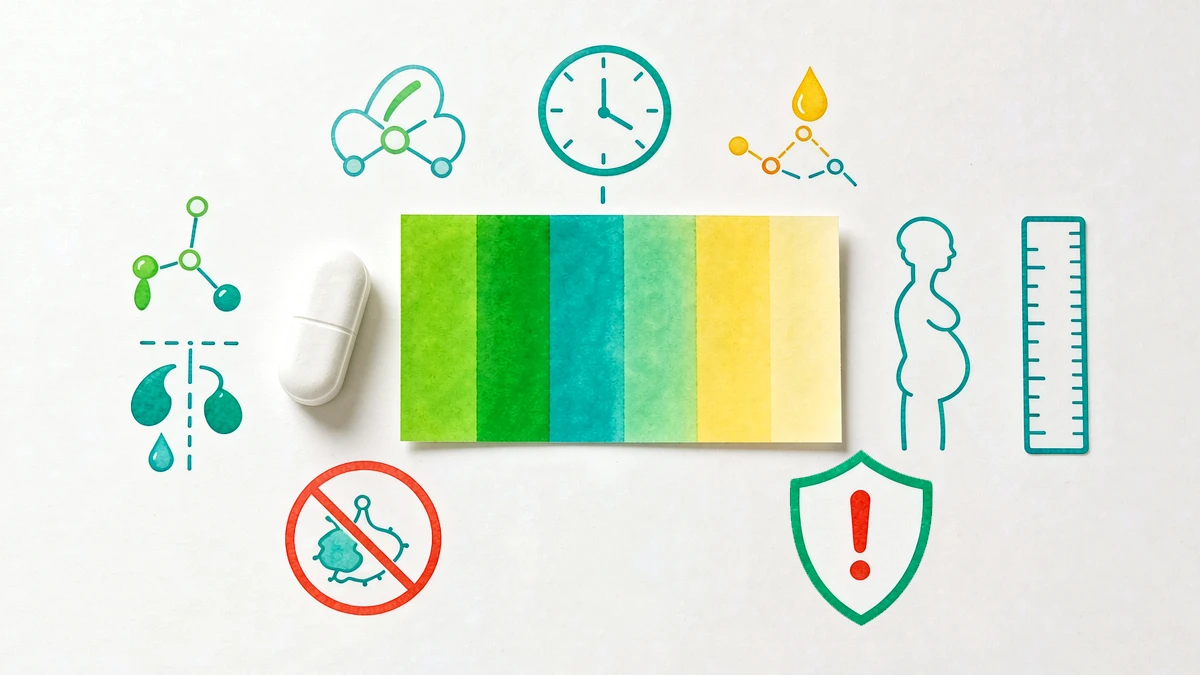
Quick Answer
Indomethacin can turn urine green or blue-green, and that color is a rare but recognized drug effect—not a sign of infection or kidney damage. The color comes from the drug’s metabolites being excreted and oxidized in urine, or in some cases from a buildup of biliverdin, a green pigment produced when old red blood cells break down. It appears while you take the medication and fades after you stop. It does not come with burning, urgency, or fever, which is how it differs from the blue-green urine of a rare Pseudomonas urinary tract infection.
In pregnancy, the safety picture is more serious than the color. Indomethacin is a nonsteroidal anti-inflammatory drug (NSAID) with well-established fetal risks. Use at about 30 weeks of gestation and later increases the risk of premature closure of the fetal ductus arteriosus. Use at about 20 weeks and later is associated with fetal renal dysfunction leading to oligohydramnios (low amniotic fluid), and in some cases neonatal renal impairment. Animal studies also show delayed parturition and increased stillbirth. The standard guidance is to limit dose and duration between 20 and 30 weeks, and to avoid indomethacin at 30 weeks and later unless the benefit clearly outweighs the risk.
The practical position: green urine is not the concern—the gestational age and the fetal risks are. If you are pregnant and taking indomethacin, do not stop it on your own, but contact your provider promptly to review whether it is still appropriate. Use the indomethacin urine guide to understand the color effect, and read on for how to tell it from infection and what the pregnancy evidence actually shows.
Why Indomethacin Turns Urine Green
Indomethacin is an NSAID used for pain, inflammation, gout, and certain types of arthritis. Green urine is an uncommon but documented effect. Two mechanisms are proposed.
The first is a direct pigment effect. The drug or its metabolites are excreted in urine and can carry a green or blue-green tint. A published case described a 16-year-old male who developed blue-green urine five days after starting indomethacin for pain; other causes were ruled out, and the color resolved after the drug was discontinued. The authors described the effect as rare and reversible.
The second involves biliverdin, a green pigment formed when old red blood cells break down. Normally, biliverdin is quickly converted into bilirubin. If that conversion is partially impaired, biliverdin can accumulate and tint urine green. A case report described green urine and a greenish skin hue after high-dose indomethacin, raising the possibility that the drug unmasked a partial enzyme deficiency. This is uncommon, but it explains why green urine from indomethacin is not always a simple pigment effect.
In most cases, the color is a benign, reversible excretion effect. It does not come with pain, fever, or a change in urination habits. The blue or green urine guide covers the full range of causes for this shade.
How to Tell Indomethacin Color From a UTI
Green or blue-green urine has two main explanations that matter here: the medication and a rare Pseudomonas aeruginosa urinary tract infection. They are told apart by symptoms, not by the shade.
Indomethacin-related green urine:
- No burning or stinging when you urinate.
- No urgency or frequency beyond your baseline.
- No fever, chills, or flank pain.
- The color tracks your medication—present while you take it, absent when you stop.
- You feel well apart from the color change.
Pseudomonas UTI:
- Burning or stinging when you urinate.
- A sudden, strong urge to pee, or passing frequent, small amounts.
- Lower abdominal or pelvic pressure.
- Fever, chills, or pain in your back or side, which can signal a kidney infection.
- Cloudy urine or a strong foul odor alongside the green tint.
The practical rule is simple: green urine without urinary symptoms is almost always the medication. Green urine with urinary symptoms is an infection until proven otherwise. The UTI symptom guide covers the infection pattern in more detail.
The Pregnancy Safety Evidence: Timing Is Everything
The risks of indomethacin in pregnancy are not uniform across all trimesters. They are gestational-age dependent, and the guidance is built around that fact.
Before 20 Weeks: Limited Data, No Established Signal
Data from observational studies on NSAID use in the first or second trimester are inconclusive regarding other potential embryofetal risks. Animal studies at doses comparable to the human dose have shown retarded fetal ossification and, at higher doses, maternal toxicity, increased fetal resorptions, and fetal malformations. But these are animal findings at doses that often exceed typical human exposure. For a woman who took indomethacin briefly before realizing she was pregnant, the absolute risk is not established, and the appropriate step is to inform her provider rather than assume harm.
20 to 30 Weeks: Limit Dose and Duration
From about 20 weeks of gestation, NSAIDs including indomethacin have been associated with fetal renal dysfunction leading to oligohydramnios, and in some cases neonatal renal impairment. These outcomes are seen, on average, after days to weeks of treatment, though oligohydramnios has been reported as early as 48 hours after starting an NSAID. In many cases, the decrease in amniotic fluid is transient and reversible with cessation of the drug, but there are case reports of neonatal renal dysfunction without oligohydramnios, some irreversible, and some requiring dialysis or exchange transfusion.
Because of this risk, the guidance for use between 20 and 30 weeks is to limit the dose and duration, and if treatment extends beyond 48 hours, to consider ultrasound monitoring for oligohydramnios. If oligohydramnios occurs, the drug should be discontinued.
30 Weeks and Later: Avoid Unless Clearly Necessary
From about 30 weeks of gestation, the risk of premature closure of the fetal ductus arteriosus becomes the dominant concern. The ductus arteriosus is a fetal blood vessel that shunts blood away from the lungs; it is kept open by prostaglandins, and NSAIDs inhibit prostaglandin synthesis. Premature closure can lead to persistent pulmonary hypertension of the newborn (PPHN) and other neonatal complications.
The standard guidance is to avoid NSAIDs, including indomethacin, starting at 30 weeks of gestation. This is not a theoretical concern. A retrospective cohort study of extremely preterm infants exposed to antenatal indomethacin found that 8.8% (6 of 68) developed PPHN, and the risk appeared higher with prolonged exposure. Other recognized neonatal risks in the third trimester include constriction of the ductus arteriosus, tricuspid incompetence, pulmonary hypertension, bleeding diathesis, and ileal perforation.
Animal Data: Delayed Parturition and Stillbirth
In animal studies, NSAIDs including indomethacin inhibit prostaglandin synthesis, cause delayed parturition, and increase the incidence of stillbirth. There are no studies on the effects of indomethacin during labor or delivery in humans, but the animal signal is one more reason the drug is not used casually near term.
What to Do If You Are Pregnant and Taking Indomethacin
Do not stop indomethacin on your own. If it was prescribed for a specific reason—such as pain control or tocolysis—stopping abruptly can have consequences. But do contact your prescriber promptly to review whether it is still appropriate for your gestational age.
What to do:
- Tell your OB or midwife that you are taking indomethacin, including the dose and how long you have been on it.
- If you are at or beyond 30 weeks, ask whether the medication should be stopped or changed, because of the ductus arteriosus risk.
- If you are between 20 and 30 weeks, ask whether ultrasound monitoring for amniotic fluid volume is needed, especially if treatment has lasted more than 48 hours.
- Do not use over-the-counter NSAIDs as a substitute without discussing it—the same class risks apply.
The pregnancy urine guide covers the broader range of color changes across trimesters.
When to Call Your Provider
Contact your OB, midwife, or prescriber if any of the following applies:
- You are pregnant and taking indomethacin—call to review the medication and the gestational-age-specific risks.
- Green urine comes with burning, urgency, fever, or flank pain—possible UTI, not just a medication effect.
- Green urine persists for more than a week after stopping indomethacin.
- You notice a decrease in fetal movement, or your provider finds low amniotic fluid on ultrasound.
- Abdominal cramping, pelvic pressure, or low backache that comes in a regular pattern—possible preterm labor.
- Vaginal bleeding or fluid leakage.
- You develop yellowing eyes or skin, pale stools, or abdominal pain—possible liver or bile duct problem.
- You have stomach pain, black stools, or vomiting blood—NSAIDs can cause gastrointestinal bleeding.
A simple urinalysis can check for infection, blood, and other markers, and turn a color question into an answer. If you are unsure whether your shade is concerning, compare it against a urine color chart and bring the pattern—medication timing, color, and symptoms—to your provider.
The Bottom Line
Indomethacin turns urine green through a rare, reversible metabolite or biliverdin effect, and the color is told apart from a Pseudomonas UTI by the absence of urinary symptoms. In pregnancy, the color is not the concern—the gestational age and fetal risks are. Use before 20 weeks has limited human data; use between 20 and 30 weeks requires limiting dose and duration and considering amniotic fluid monitoring; use at 30 weeks and later should be avoided because of the risk of premature ductus arteriosus closure and PPHN. If you are pregnant and taking indomethacin, do not stop it on your own, but call your provider promptly to review the plan. The green urine will fade; the fetal risks are what need attention.