Dark Brown Urine After Exercise: Rhabdomyolysis Red Flags
Quick Answer
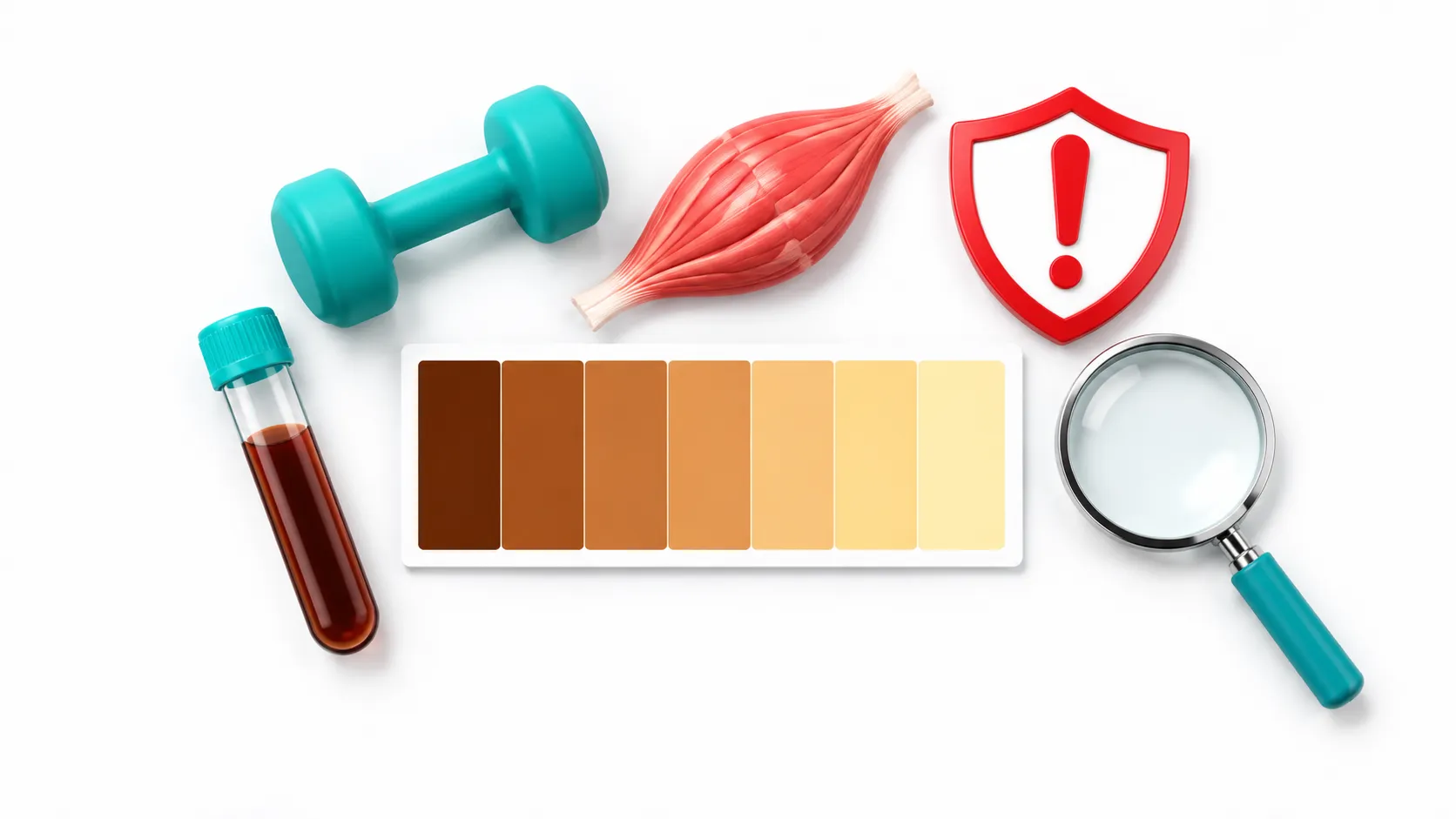
Dark brown, cola-colored, or tea-colored urine after exercise is the color that should stop you in your tracks. Light pink urine after a workout is usually harmless exercise-induced hematuria. But dark brown urine—especially when it comes with muscle pain, tenderness, weakness, or swelling—is the pattern of rhabdomyolysis, the rapid breakdown of skeletal muscle that releases myoglobin into the bloodstream and can lead to acute kidney injury.
The classic triad of muscle pain, weakness, and dark urine is present in fewer than 10% of cases, so the absence of all three does not rule it out. Symptoms may not appear until hours or even several days after the triggering exercise. The diagnosis is confirmed by a blood test for creatine kinase (CK), not by the color of your urine alone. If you have dark brown urine with any muscle symptoms after a hard or unaccustomed workout, seek urgent care. Do not wait to see if it clears. Use the brown urine guide to compare your shade, and read on for the red flags that matter.
Why Rhabdomyolysis Turns Urine Dark Brown
Rhabdomyolysis is the breakdown of skeletal muscle tissue. When muscle fibers disintegrate, they release their intracellular contents into the bloodstream, including myoglobin, creatine kinase (CK), and electrolytes such as potassium and phosphate.
The kidneys filter myoglobin into urine. Myoglobin itself is a dark red-brown pigment, which is why urine turns the color of cola or tea. But myoglobin is also directly toxic to the kidney tubules, and the fluid shifts and electrolyte disturbances that accompany muscle breakdown compound the injury. The result can be acute kidney injury (AKI), which is the complication that makes rhabdomyolysis dangerous.
The color is not blood in the usual sense. A urine dipstick may be positive for “blood” because it detects heme pigments, but microscopy shows few or no red blood cells—the pigment is myoglobin, not intact cells. That is one reason a dipstick alone cannot diagnose rhabdomyolysis, and why a blood CK test is required.
The Red Flags: Symptoms That Travel With Dark Brown Urine
Dark urine alone can have many causes. The red flags are the symptoms that accompany it. Seek urgent medical care if you have dark brown, cola-colored, or tea-colored urine plus any of the following:
- Muscle pain, tenderness, or aches that are more severe than expected for the amount of exercise you did.
- Muscle weakness—an inability to complete a workout or daily tasks you could previously do, or a feeling of unusual fatigue in the muscles.
- Muscle swelling or a feeling of tightness or firmness in the affected muscles.
- Nausea, vomiting, or abdominal pain.
- Fever, malaise, or a rapid heart rate.
- Very little urine output, or no urination for many hours.
- Confusion, extreme weakness, or fainting.
These symptoms can mimic heat cramps or simple dehydration, which is one reason rhabdomyolysis is underrecognized. The distinguishing feature is the severity and persistence of the muscle symptoms alongside the dark color. If you are unsure, treat it as a reason to get checked. The after-exercise urine guide covers the benign post-workout patterns for comparison.
How Rhabdomyolysis Differs From Exercise Hematuria and Dehydration
The three can be confused, but they behave differently.
Exercise-induced hematuria:
- Color: light pink, red, or tea-colored.
- Symptoms: none, or mild flank discomfort. No muscle pain, weakness, or swelling.
- Timing: clears within 24 to 72 hours of rest and hydration.
- Urine test: red blood cells present on microscopy; CK is not markedly elevated.
Dehydration:
- Color: dark yellow, golden, or amber—not brown or cola-colored.
- Symptoms: thirst, dry mouth, fatigue, dizziness on standing. No muscle pain or swelling.
- Timing: lightens within 1 to 3 hours of drinking water.
Rhabdomyolysis:
- Color: dark brown, cola-colored, or tea-colored, visibly darker than simple pink.
- Symptoms: muscle pain, weakness, tenderness, or swelling, sometimes with nausea, fever, or malaise.
- Timing: does not correct with fluids; symptoms may worsen over hours to days.
- Urine test: dipstick positive for heme with few or no red blood cells on microscopy—the signature of myoglobinuria.
- Blood test: CK is markedly elevated.
The practical rule: light pink that clears in a few days is usually benign. Dark cola-colored urine that does not clear, especially with muscle symptoms, is rhabdomyolysis until proven otherwise.
The CK Threshold: How Rhabdomyolysis Is Confirmed
Urine color is a prompt, not a diagnosis. The diagnosis is made by a blood test for creatine kinase (CK).
The threshold commonly used is a CK level greater than 5 times the upper limit of normal, which is roughly greater than 1,000 IU/L. In practice, the CK level is usually much higher:
- Nonexertional rhabdomyolysis: CK is usually greater than 5,000 units/L.
- Exertional rhabdomyolysis: CK is usually greater than 10,000 units/L.
CK begins to rise within 2 to 12 hours of muscle injury and peaks at 24 to 72 hours. That timing is why a normal CK very early after exercise does not fully exclude the diagnosis, and why serial testing may be needed. A urine dipstick is not reliable for ruling rhabdomyolysis in or out, because myoglobin clears quickly from the body while CK remains elevated for days. The blood test is the one that matters.
Why Early Treatment Matters
The main goal of treatment is to prevent acute kidney injury. Myoglobin is nephrotoxic, and damaged muscle sequesters fluid, leading to relative dehydration. Aggressive intravenous fluid replacement is the cornerstone of management—it maintains renal blood flow and reduces the concentration of myoglobin in the tubules. In severe cases, electrolyte disturbances (especially high potassium) may require urgent treatment, and dialysis may be needed if kidney injury develops.
This is why the timeline matters. The earlier rhabdomyolysis is recognized and fluids are started, the lower the risk of permanent kidney damage. Waiting to see if the dark color clears on its own is the wrong approach when muscle symptoms are present.
When to Seek Emergency Care
Seek urgent care or go to the emergency department if any of the following applies after exercise:
- Dark brown or cola-colored urine, especially with muscle pain, weakness, or swelling.
- Muscle pain that is more severe than expected for the exercise, or that persists and worsens over hours to days.
- Muscle weakness that prevents you from completing normal tasks or a usual workout.
- Very little urine output, or no urination for many hours.
- You feel confused, very weak, lightheaded, or your heart is racing.
- Nausea, vomiting, or fever with dark urine.
- Pink or red urine that persists beyond 72 hours after the workout, even without muscle symptoms.
Contact your primary care provider if the muscle symptoms are mild and the urine color is light, but do not delay if the color is dark brown or the symptoms are significant. A simple blood test can measure CK and kidney function, and turn a worrying color into a clear answer. If you are unsure whether your shade is concerning, compare it against a urine color chart and bring the pattern—workout type, timing, color, and muscle symptoms—to your doctor.
The Bottom Line
Dark brown or cola-colored urine after exercise is a red flag for rhabdomyolysis, especially when it comes with muscle pain, weakness, tenderness, or swelling. The classic triad is absent in most cases, so the absence of all three symptoms does not rule it out. Light pink urine that clears in a few days is usually benign exercise hematuria; dark cola-colored urine that does not clear is not. The diagnosis is confirmed by a blood CK test, and early intravenous fluids are what prevent kidney injury. If you have dark brown urine with muscle symptoms after a hard or unaccustomed workout, seek urgent care. Do not wait for the color to clear on its own.